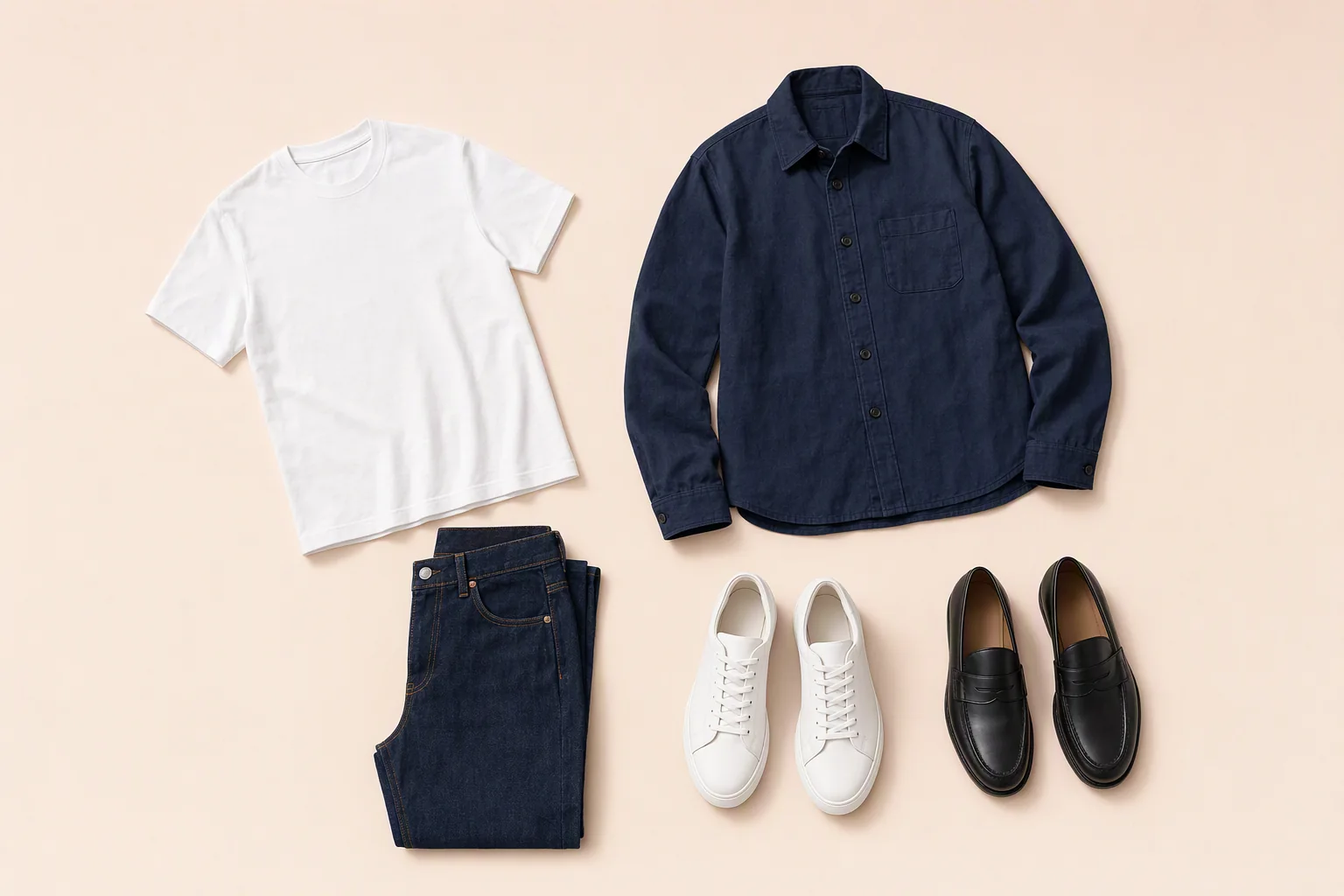
To decide what to wear today, start with where you are going, the weather you will actually encounter and the shoes your day requires. Pick a familiar combination from your own clothes, then change only what those conditions demand. The aim is to leave with one workable outfit, rather than evaluate everything in your wardrobe.
Set today's three constraints
Before opening another inspiration board, answer three questions:
- Where must this outfit work? Name the most demanding commitment: a client meeting, school pickup or dinner at a particular venue. Follow a stated dress code when there is one.
- What will the journey feel like? Check the forecast for your time outside, including rain and wind. An afternoon high does not describe an early commute or the trip home.
- What must you move in? Walking, cycling, standing and sitting can each rule out different clothes. Start with shoes you already know suit the activity.
Now remove unavailable choices: clothes in the wash, a skirt needing a repair, or trousers that feel uncomfortable today. Put them outside this decision. You can deal with them later.
Choose one of three fallback outfits
These are suggested starting combinations, not a shopping list. Use the closest pieces you own and adjust for your preferences and dress code.
| Today's main use | Starting outfit | An owned-clothes substitution |
|---|---|---|
| Casual errands or a relaxed day | White cotton T-shirt, straight blue jeans, worn-in sneakers, cotton overshirt | A striped tee, chinos or zip cardigan can fill the same roles |
| An office that allows smart casual | Navy fine-knit top, grey trousers, comfortable loafers, unstructured blazer | Use a collared shirt, black trousers or neat cardigan already in your wardrobe |
| Informal dinner or meeting friends | Black knit top, dark jeans, familiar ankle boots, jacket | Use a midi dress and cardigan, or swap the jeans for trousers |
Pick the row closest to your actual day. You do not need to try all three. If dresses or jumpsuits are your easiest option, treat the one-piece garment as the base and make the same shoe and layer decisions.
Give each formula a real name in your notes: “navy crewneck + grey ankle trousers + black loafers.” “Something smart” leaves the decision unfinished.
Work through a day with competing needs
The following is an editorial example to show the method, not a recorded outfit test or a current weather report.
The day: A smart-casual office, a walk to the station and rain expected on the way home.
The clothes available: A blue cotton shirt, charcoal trousers with hems clear of the ground, black loafers, waterproof ankle boots and a hooded raincoat.
The choice: Blue shirt + charcoal trousers + familiar waterproof boots + raincoat. Keep the office base; change the footwear and outer layer for the journey.
If your wardrobe differs: Use a plain knit instead of the shirt, dark jeans if your office permits them, and your own rain-appropriate walking shoes. Check the shoes' care guidance rather than assuming all leather footwear is waterproof.
An umbrella may be enough for a brief shower on a short route; persistent rain or an exposed walk may call for a more protective layer. The practical check is whether the exact outfit suits your route. If you change into office shoes, include the pair you need to carry.
Fix one problem, then stop comparing
Put on the complete outfit, including shoes and the outside layer. Sit, reach forward and walk around. Look for a specific issue: a waistband that digs in, a sleeve that bunches inside the jacket, or a hem that drags.
Change the item responsible. If wide trousers catch under your shoes, choose an existing shorter pair. If the coat feels bulky over a thick sweater, try a thinner top if it still provides enough warmth. If everything works but you want more interest, use one familiar detail: a patterned scarf, earrings or a different bag.
Your stopping rule: suitable for the occasion, comfortable in motion, adequate for the forecast and ready to wear. Once those checks pass and you like the result, another round of comparisons is optional.
Leave yourself a useful starting point for tomorrow
Take an outfit photo or write the exact garment names in a note. Include the reason it worked: “boots comfortable for station walk” is more reusable than “nice outfit.” Keep three reliable choices available, allowing for laundry, rather than requiring yourself to invent a different look each morning.
The free weekly outfit planner can organize named garments into an editable five-day draft. It combines item names; it does not judge colors, inspect photos or check the weather. Review the draft, then copy or print the combinations you want to use.
If even the clean, available clothes repeatedly feel impossible to combine, use the full-closet diagnosis when you have room to examine the pattern.
Use a photo wardrobe when you need fresh combinations
FITPOP's official iPhone listing, checked 9 October 2026, describes batch garment capture, a digital wardrobe, daily outfit ideas and styling around a selected item. The own-clothes outfit generator guide explains this separate app workflow. Check any suggested outfit against your real clothes, comfort and plans before wearing it.
For today, choose the constraint, name the clothes and make the necessary swap. An outfit you already own can be the finished decision.