
A capsule wardrobe is a small, intentional set of clothes that mix and match into far more outfits than the piece count suggests. The point is not to own less for the sake of less — it is to own pieces that work together, so getting dressed becomes effortless and nothing sits unworn.
And the best part: you almost certainly already own a capsule. It is just buried inside a closet of pieces that do not talk to each other.
Step 1: Audit what you already have
Before buying a single thing, lay out everything you actually wear. You will usually find that a small core — maybe 20 to 30 pieces — already powers 90% of your outfits. Those are your capsule candidates.
Pull out the pieces you reach for repeatedly. Note what they have in common: probably a consistent color family, fabrics you find comfortable, and silhouettes that fit your life.
Step 2: Find your color palette
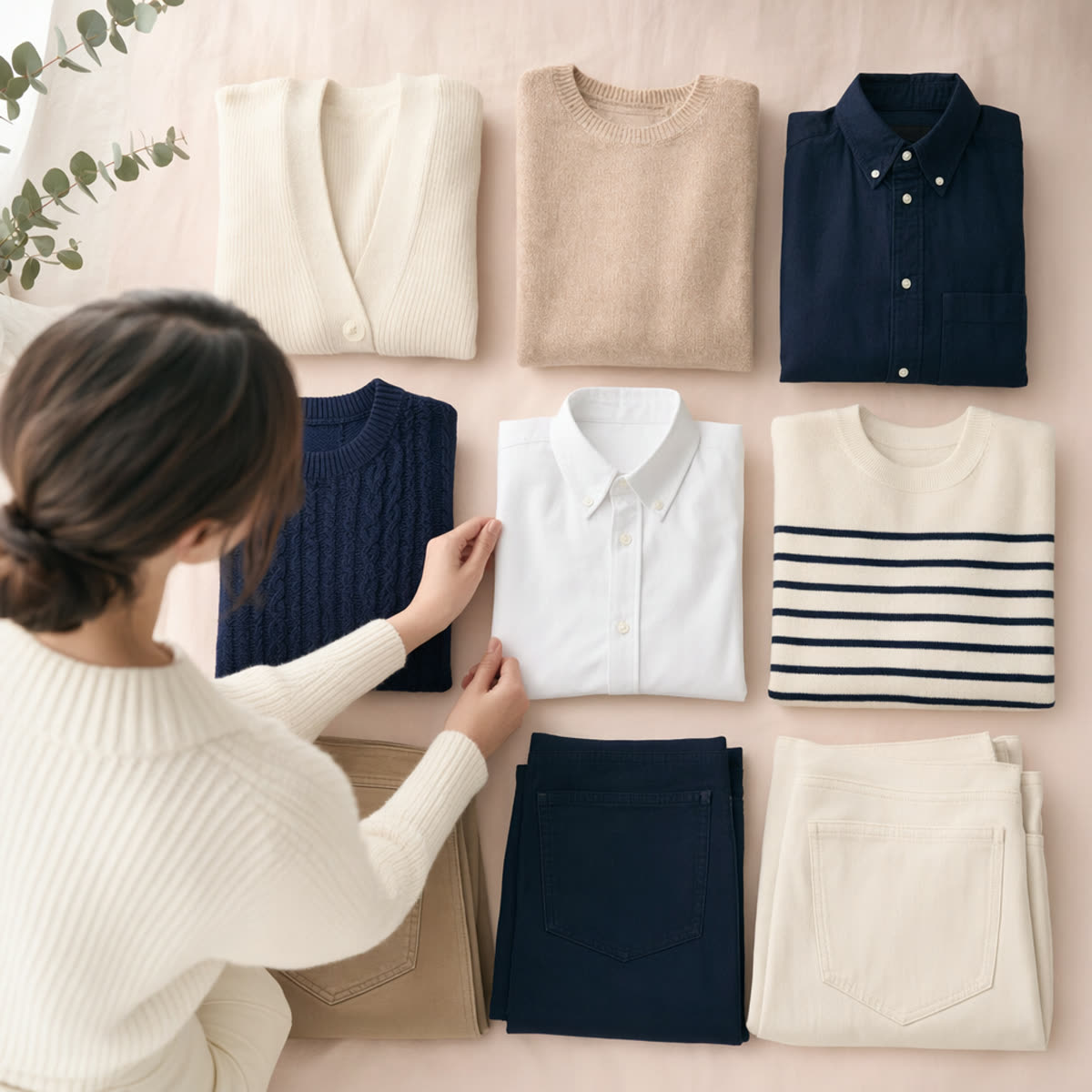
A capsule works because the pieces share a palette. Pick two or three neutrals (black, navy, cream, tan, grey) as your base, then one or two accent colors that flatter you. When every piece lives in the same palette, almost any top pairs with almost any bottom.
Step 3: Cover the core categories

A flexible season-spanning capsule usually covers:
- 3–5 tops that layer well
- 2–3 bottoms that all pair with those tops
- 1–2 layering pieces (a blazer, a cardigan, a jacket)
- 1 dress or jumpsuit that needs no styling
- 2–3 pairs of shoes that cross casual-to-dressy
Multiply it out: 4 tops × 3 bottoms is already 12 outfits before you add layers.
The outfit math nobody shows you
Here is the idea that makes a capsule click: the value is not in the pieces, it is in the combinations between them. And combinations scale far faster than the piece count.
Take a modest core — 5 tops, 4 bottoms, 2 layers, 3 pairs of shoes. That is 14 items. But the outfits they produce are not 14; they are closer to 5 × 4 × 3 (top × bottom × shoe), or 60 base looks, before you factor in the two layers that each roughly double the count again. Fourteen pieces, well chosen, comfortably hold a month of non-repeating outfits.
This is why "I have nothing to wear" is almost never a shortage of clothes. It is a shortage of combinations you can see. Most people wear the same ten outfits out of the hundreds their closet can technically make, because the other looks never occur to them standing half-awake in front of the rail. The whole point of a capsule is to shrink the piece count until the combinations become visible and every one of them works.
The rules that keep every piece compatible
For that multiplication to hold, the pieces have to be genuinely interchangeable. Three constraints do almost all the work:
- One palette, no exceptions. Every top must pair with every bottom. That only happens if they share a tonal family — your two or three neutrals plus one or two accents. A single "orphan" color that goes with nothing quietly breaks the math.
- Consistent formality. Keep the capsule within one or two adjacent dress levels (say, casual to smart-casual). A cocktail dress and gym leggings both technically live in your closet, but neither combines with the core, so both sit outside the capsule.
- Repeatable silhouettes. Fits that tuck, layer, and cuff the same way swap in for each other freely. When every top can be tucked into every bottom, you unlock the half-tuck and the layer variations that multiply looks further.
Common capsule mistakes
Most failed capsules fail the same few ways:
- Buying the "perfect 30" from scratch. A capsule assembled in one shopping trip is a stranger's wardrobe. The pieces that actually get worn are the ones you already reach for — start from those, not from a list.
- One statement piece that pairs with nothing. The bold printed jacket you love but can only wear one way is not capsule material. Keep statements to accents, not foundations.
- Neglecting shoes. Shoes cap your real outfit count more than tops do. Two or three that cross casual-to-dressy stretch the whole capsule; a pile of single-purpose shoes shrinks it.
- Ignoring the life you actually live. Build for your real week — the ratio of work, weekend, and dressy days you genuinely have — not the glamorous one on the mood board.
If your capsule keeps growing back into clutter, the issue is usually upstream: too much still in the closet, drowning the core. A focused closet declutter is the fastest way to let the capsule surface, and a short list of true wardrobe essentials tells you which gaps are worth filling.
Step 4: Only then, fill real gaps
After the audit, you will see genuine gaps — maybe you have no neutral layer, or no shoe that works for both work and weekend. Those are the only things worth buying. Everything else, you already have.
Let your closet do the math for you
The hard part of a capsule is not the rules — it is seeing every combination your existing clothes can make. That is where FITPOP helps: it digitizes the clothes you already own and generates outfit formulas from them, so your capsule reveals itself instead of being guesswork. You can preview combinations on your digital twin and discover that your "I have nothing to wear" closet actually holds dozens of looks.
The mindset shift
A capsule wardrobe is less about buying the perfect 30 pieces and more about rediscovering the versatile core you already own — then wearing it with intention.
Test your capsule against an ordinary week with the free weekly outfit planner. If you prefer photo-based organization, follow the digital wardrobe setup checklist.