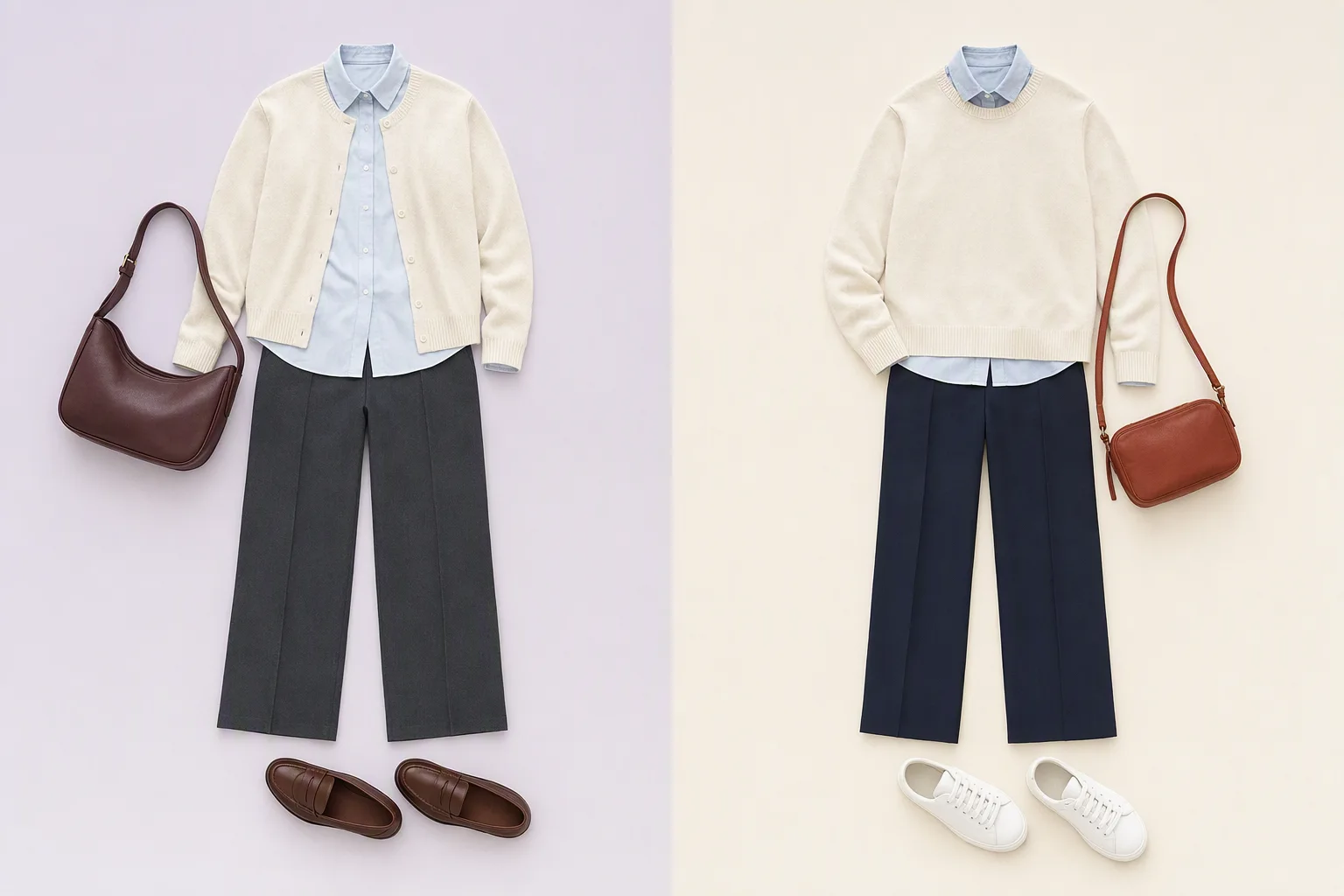
To recreate an outfit with your own clothes, translate the relationships between its pieces into garments you own. Look at silhouette, color, texture, layers and shoes together. You can preserve the part of a complete look you enjoy without matching its labels or buying every pictured item.
A public discussion about recreating saved outfits includes readers working with similar colors and shapes from their wardrobes. Our example below is an original editorial text reference, not a copied fashion photograph or an app-generated result.
Read the complete reference before selecting substitutes
Here is the reference we are recreating: a short, soft cream cardigan over a pale blue collared shirt, dark straight trousers, brown loafers and a small burgundy shoulder bag. The assumed setting is a mild, dry day with a casual meeting followed by a walk to a café.
The key relationships are a lighter upper half above a darker bottom, a visible collar under a soft layer, a straight trouser shape and smaller areas of warm color. These descriptions specify this example; they are not universal rules for a good outfit.
Choose the features you most want to preserve. For this exercise, prioritize the light-dark relationship and the soft-layer-over-collar combination. Exact brown shoes and the exact bag size are secondary.
Put the available wardrobe beside it
Our example inventory contains a cream fine-knit pullover, a pale blue cotton shirt, navy straight trousers, familiar white sneakers, a rust-colored crossbody bag and a stiff cream utility jacket. No new item is added to complete the look.
| Reference role | Owned substitute | What stays, what changes |
|---|---|---|
| Soft, light upper layer | Cream fine-knit pullover | Light color and soft surface stay; front buttons disappear. |
| Visible collar | Pale blue cotton shirt | Collar and pale color stay. |
| Dark straight bottom | Navy straight trousers | Darker lower half and straight silhouette stay. |
| Comfortable shoe for the journey | White sneakers | Walking role stays; brown color and loafer shape change. |
| Small warm-color accent | Rust crossbody bag | Warm accent stays; color, size and strap arrangement change. |
A substitute can preserve one function while changing another. Make that tradeoff visible instead of treating similarity as an all-or-nothing judgment. If the brown footwear was the part you loved most, you would choose different priorities and might produce a different outfit.
Show one failed substitute and why it failed
The stiff cream utility jacket matches the reference's color more closely than some other options. In this editorial scenario, however, its bulky sleeve feels restrictive over the shirt and its firm shape loses the soft layer the reader wanted.
We reject that jacket for this recreation, not for every outfit. The problem is the combined sleeve space and desired texture, not the wearer's body. The fine-knit pullover is the next candidate because it better preserves the chosen softness.
Try the pullover over the actual shirt. If the combination still pulls when reaching, compare another existing layer, wear the shirt alone or revise the reference. An appealing mapping on paper does not guarantee a comfortable physical result.
Assemble the finished look and check the day
The finished editorial combination is cream pullover over pale blue shirt + navy straight trousers + white sneakers + rust crossbody bag. The shirt collar remains visible. Try the shirt hem tucked or untucked according to comfort and the outline you prefer.
This version keeps the light upper half, dark straight bottom, soft-over-crisp layering and warm bag accent. It changes the cardigan opening, footwear color and bag shape. Those are explicit differences, not errors to hide.
Walk, sit, reach and carry the loaded bag. Check the trouser hem with the sneakers, the sleeves inside the pullover and the actual meeting expectations. If rain or lower temperatures require a suitable coat, add one you own and reassess the whole outfit; do not assume the text reference covers every condition.
Save the translation, not a shopping list
Record the reference's two priorities, the substitutions and the failed jacket choice. That record makes another attempt easier: you know which feature mattered and which garment interaction did not work. Use the fit and layering checks when sleeve room, rise or hem length is the obstacle.
FITPOP's official listing, checked 9 October 2026, describes a digital wardrobe and outfits built around a selected saved garment. After making this manual mapping, you can explore more combinations around an owned piece. This guide does not assume screenshot import, automatic reference analysis or a guaranteed physical fit.
Wear the finished version if it suits your plans, then note what you would repeat. The outfit repetition example helps carry a successful look into another suitable occasion. The useful outcome is a wearable outfit from your wardrobe, with the reference helping you see a combination you had not tried.